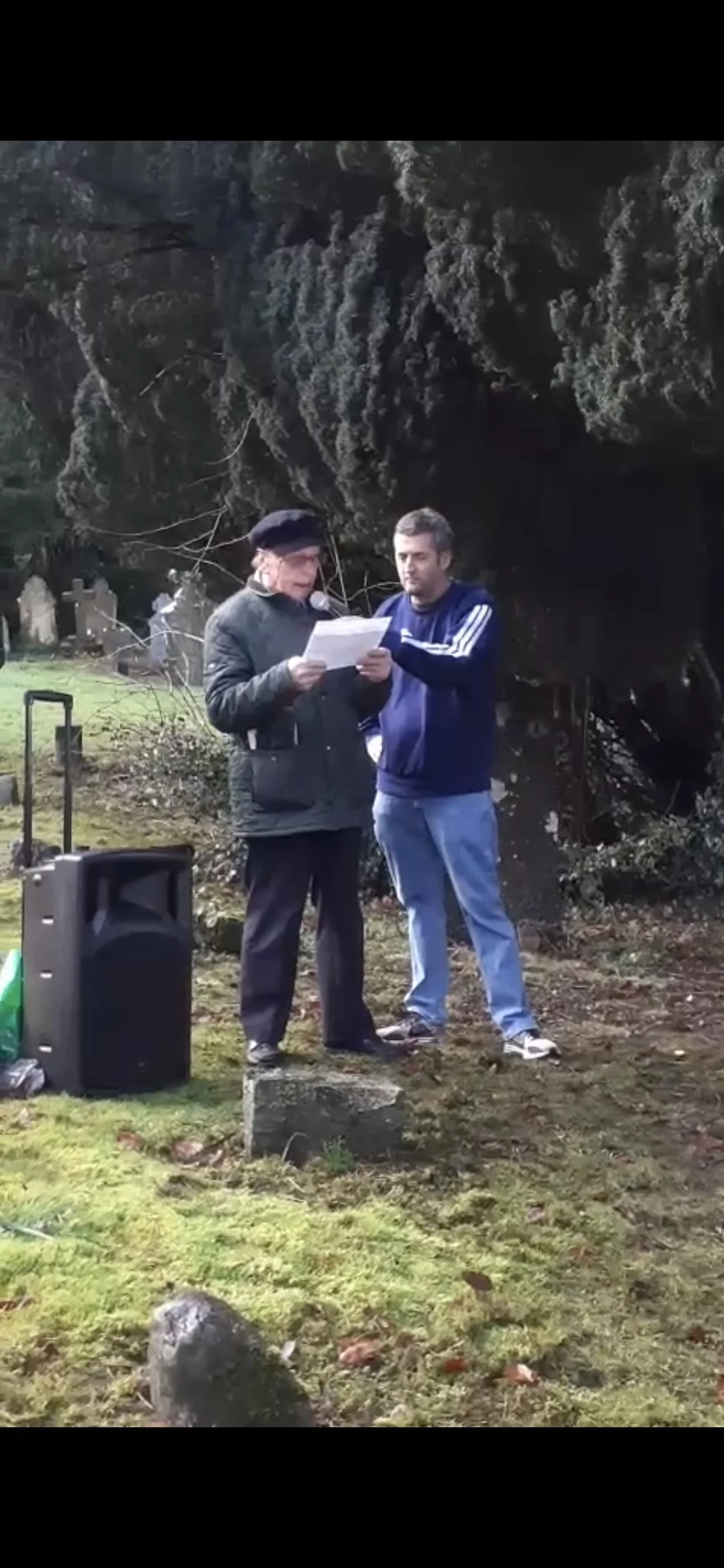
James Lillis Commemoration 2026
Volunteer James Lillis Commemoration, Carlow, 18/01/2026.
The following was read by Phil O'Donoghue of the 32 County Sovereignty Movement.
As we commence a new year we must recognise that the Republic proclaimed and established in the period in which Volunteer James Lillis fought and died is drifting ever further away. And like those seminal years in the republican struggle, world events were central in shaping the direction in which the republican struggle would travel. Republicans today are living in a similarly changing world with seismic shifts in geo-politics, with world powers actively engaged in territorial expansion, the hijacking of natural resources and a renewed and dangerous arms race.
The political reasoning behind partition alters and adapts to the differing needs of the British establishment to preserve it. And because the Good Friday Agreement does not oblige the Twenty-Six County State to pursue the ending of Partition those British needs will go unchallenged. This is the political and constitutional vacuum which Irish republicans must fill. But we cannot simply bring green rhetoric or ideological slogans to a political theatre were political acumen and keen insight are essential if any republican impact is to be made.
The first step in resolving any problem is to recognise that the problem exists, and this unassailable logic must, in the first instance, be applied to ourselves. There are stark realities that republicans must accept if a realistic and effective strategy is to be developed. From the outset we must understand that, because the recent phase of the conflict has been over for longer than it was engaged in, there is a new political generation which has no practical empathy with that phase of the struggle. And this is the very generation that Irish republicans must engage with now.
The primary objective of Irish republicanism is a sovereign democratic republic. The arguments for national sovereignty and national democracy are one and the same. It is the salient task of Irish republicans to convince this generation of our people that within that national framework alone can Irish society progress along truly genuine republican principles.
Recognising that each generation of Irish republicans have strategic autonomy to pursue our perennial right to national self-determination, it is that right which is necessarily carried forward and not any given strategy or stance taken in its pursuit. We cannot confine ourselves to old tactics in the false belief that we are in some way obligated through tradition to adopt them. Our tactics and strategies must first and foremost be judged on their effectiveness in a contemporary context and not their perceived loyalty to the past.
The Twenty-Six County State has evolved beyond the circumstances of its birth. The argument of illegitimacy is strategically redundant. British withdrawal from Ireland will not occur independent of this State. The logical conclusion is that republicanism must develop and design means in which the State can be influenced towards a pursuit of the restoration of our national sovereignty. This will require fresh and original thinking and the revolutionary courage to see it through.
Staying outside the apparatus of the State as a symbolic stance only confers a distinction of political bankruptcy on Irish republicanism. Existing within the apparatus of the State is nothing more than sheepish conformity. Irish republicanism must forge a third route. The Republican Movement cannot achieve its primary objective on its own. Strategic alliances need to be built. Republicanism is not a position to hold but an activity to advance.
British government’s do have selfish, strategic and economic reasons for remaining in the Six Counties. Identifying these reasons is fundamental in determining strategies against them. Issues such as neutrality, immigration and a political system based on merit and representative democracy offers republicans fertile ground to stir a national consciousness. But just as the previous phase of the national struggle developed its own language to communicate its core objectives a new language must now be developed to communicate within a very different political landscape.
Volunteer James Lillis did not give his life for praise or veneration. He gave it based on an absolute faith that those who came after him would develop ideas to see the job done. He places his faith in us: if we truly want to honour him let us ensure that his faith was not misplaced.
Beri Bua!